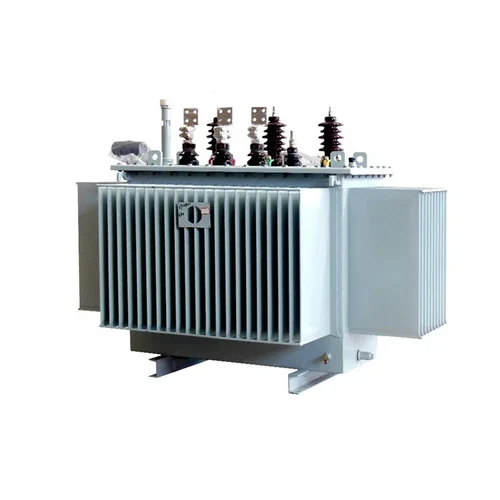
DISTRIBUTION TRANSFORMER
RuncoN Distribution Transformer is a type of transformer used in the final stage of power delivery — it reduces medium voltage from the distribution network to a level that can be safely used by homes and businesses.
What a Distribution Transformer Does
It converts medium voltage down to usable levels as the last step before electricity reaches consumers.
| Input Voltage | Output Voltage | Usage |
|---|
| 11 kV / 33 kV | 415 V | 3-phase (commercial/industrial) |
| 415 V | 230 V | Single-phase (homes) |
How It Works
It operates on electromagnetic induction.
- AC supply in the primary winding creates a magnetic field.
- This field induces voltage in the secondary winding.
- Output voltage depends on the turns ratio.
Main Parts
- Core: Magnetic path made of laminated steel.
- Primary Winding: High voltage input.
- Secondary Winding: Low voltage output.
- Transformer Oil: Cooling and insulation.
- Tank: Houses all components.
- Bushings: Terminals for connection.
- Breather: Keeps moisture out.
Types
- Pole-Mounted Transformer: Seen on electric poles in rural and urban areas.
- Pad-Mounted Transformer: Ground-mounted, used in cities with underground cables.
- Single-phase
- Three-phase
Typical Ratings
| Parameter | Value |
|---|
| Power Rating | 25 kVA to 2500 kVA |
| Primary Voltage | 11 kV / 33 kV |
| Secondary Voltage | 415 V |
| Frequency | 50 Hz |
Key Characteristics
- Designed for continuous operation (24/7).
- High efficiency at low load.
- Low core losses — important because it is always ON.
Power Flow Example
- Power comes from substation at 11 kV.
- Distribution transformer steps it down.
- Output becomes 415 V (3-phase).
- Homes receive 230 V (single-phase).